📅 Updated: March 2026 | ⏱ 18 min read | ✍️ PassNISM Editorial Team
NISM Series V-A (Mutual Fund Distributor) – The Complete 2026 Guide: Syllabus, Pass Marks, Exam Tips & Career Roadmap
Every road to becoming a mutual fund distributor in India leads to one exam: NISM Series V-A. Over 2 lakh candidates appear for it every year — yet most fail to prepare the right way. This guide covers everything you need to pass NISM 5A on your first attempt: syllabus, pass marks, chapter-wise weightage, a 7-day study plan, ARN registration steps, and a clear career income roadmap. No fluff. Let's get into it.
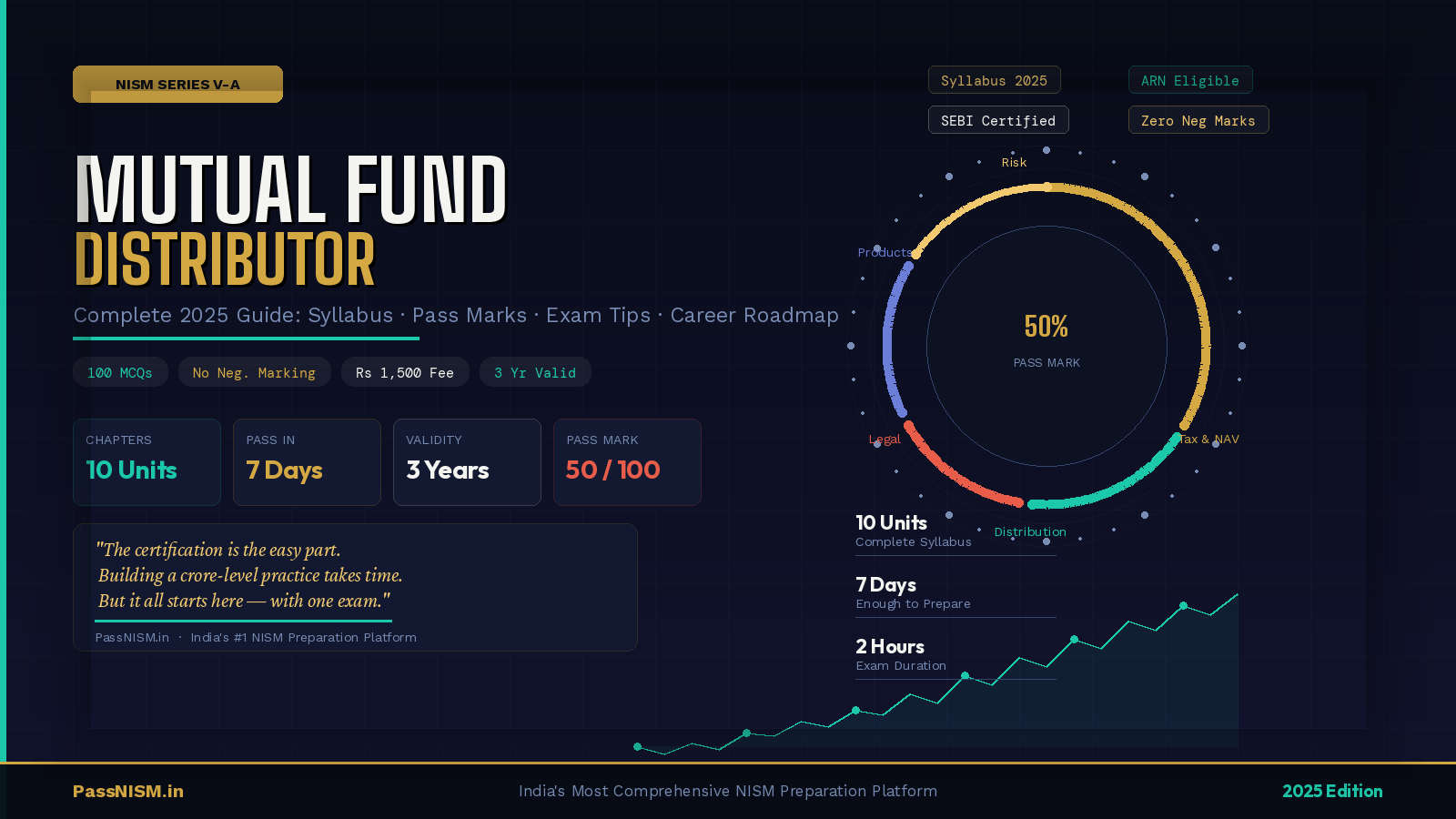
100 Questions 50% Pass Marks ₹1,500 Exam Fee + GST 120 Minutes 3 yrs Validity ZERO Negative Marking
Table of Contents
- What Is NISM Series V-A?
- Who Should Appear?
- Exam Pattern & Pass Marks (2026)
- Complete Syllabus with Chapter Weightage
- 7-Day Study Plan
- 5 Mistakes That Cause Failures
- Registration: Step-by-Step
- After You Pass: ARN & Career Roadmap
- Key Formulas to Memorise
- Essential Glossary
- Frequently Asked Questions
What Is NISM Series V-A? (And Why It Actually Matters)
The NISM-Series-V-A: Mutual Fund Distributors Certification Examination is conducted by the National Institute of Securities Markets (NISM) — a body set up by SEBI in 2006. Here is the fundamental rule: You cannot legally sell or distribute mutual funds in India without this certification.
Once you pass the NISM 5A exam, you become eligible to apply for your ARN (AMFI Registration Number) — the official licence that lets you earn trail commissions by helping investors put money into mutual funds. No ARN = No commissions = No distribution business.
Who Should Appear for NISM Series V-A?
This exam is designed for:
- Aspiring Mutual Fund Distributors who want to start their own distribution business
- Bank employees and Relationship Managers who recommend mutual funds to customers
- AMC employees involved in sales and distribution
- Insurance agents looking to add mutual funds to their product portfolio
- Finance graduates and freshers building a career in BFSI
- Homemakers, retired professionals, and side-income seekers who want to earn MF commissions
Minimum eligibility: No strict qualification is mandated. You must be 18 years or above. Many successful MF distributors come from non-finance backgrounds — teachers, engineers, homemakers — who cracked this exam and built six-figure annual incomes.
NISM 5A Exam Pattern, Pass Marks & Key Details (2026) Parameter Details Full Name NISM-Series-V-A: Mutual Fund Distributors Certification Examination Conducted By NISM (National Institute of Securities Markets) — set up by SEBI Total Questions 100 Multiple Choice Questions (MCQs) Total Marks 100 marks (1 mark per question) Pass Marks 50 out of 100 (50%) Exam Duration 120 minutes (2 hours) Negative Marking None ✓ Exam Fee ₹1,500 + GST Certificate Validity 3 years from date of passing Mode Online Computer-Based Test at NISM centres Language English or Hindi (Hindi at physical centres only) Registration Validity 180 days from registration to appear for the exam
🎯 Start Practising Now — Free NISM 5A Mock Tests
Our mock tests mirror the real NISM Series V-A exam pattern with detailed answer explanations. Thousands of candidates use PassNISM to pass for sure.
Take Free NISM 5A Mock Test → NISM Series V-A Syllabus 2026 – Complete Chapter-by-Chapter Breakdown
The NISM V-A syllabus has 10 units. Below is the complete breakdown with estimated exam weightage, key concepts, and exam tips for each chapter.
Unit Chapter Name Approx. Questions 1 Investment Landscape 8–10 2 Concept and Role of a Mutual Fund 10–12 3 Legal Structure of Mutual Funds in India 6–8 4 Offer Documents 6–8 5 Fund Distribution and Channel Management 8–10 6 ⭐ Accounting, Valuation & Taxation — MOST IMPORTANT 15–18 7 Net Asset Value, TER, and Pricing of Units 6–8 8 Investor Services 8–10 9 Risk, Return, and Performance of Funds 8–10 10 Mutual Fund Scheme Types and Asset Classes 10–12 Unit 1: Investment Landscape (8–10 Questions)
Builds the foundation. Covers the Indian economy, types of investors, savings vs. investment, risk vs. return, financial assets (equity, debt, real estate, gold), inflation risk, real returns, investor risk profiling, and behavioural biases.
Unit 2: Concept and Role of a Mutual Fund (10–12 Questions)
Covers what a mutual fund is, how it pools money, and roles of key participants: AMC, Trustee, Custodian, and RTA. Also covers SEBI, AMFI, NISM regulatory roles and the history of mutual funds in India (UTI era to present).
Unit 3: Legal Structure of Mutual Funds in India (6–8 Questions)
Covers the three-tier structure: Sponsor → Trust → AMC. Focus on Trustee responsibilities, SEBI Mutual Fund Regulations 1996, and net worth requirements for sponsors and AMCs.
Unit 4: Offer Documents (6–8 Questions)
Covers Scheme Information Document (SID), Statement of Additional Information (SAI), and Key Information Memorandum (KIM). Mandatory vs. non-mandatory disclosures, update frequencies, and fund factsheet components.
Unit 5: Fund Distribution and Channel Management (8–10 Questions)
The most practical chapter. Covers Direct vs. Regular plans, ARN registration process, EUIN (Employee Unique Identification Number), KYD norms, AMFI Code of Conduct, upfront vs. trail commissions, and clawback provisions.
⭐ Unit 6: Accounting, Valuation & Taxation — The Most Important Chapter (15–18 Questions)
This is the make-or-break chapter for NISM Series V-A. Master: NAV calculation, TER, exit load, dividend vs. growth options, capital gains tax (LTCG vs. STCG), indexation, Section 80C benefits, and ELSS lock-in period.
Capital Gains Tax Summary (2026):
- Equity Funds – LTCG (held >1 year): 12.5% on gains above ₹1.25 lakh/year
- Equity Funds – STCG (held <1 year): 20%
- Debt Funds: Taxed as per investor's income tax slab (no indexation for investments after April 2023)
Quick Example: Total assets = ₹50 cr, liabilities = ₹2 cr, units = 4 cr. NAV = (50−2) ÷ 4 = ₹12 per unit
Unit 7: NAV, TER, and Pricing of Units (6–8 Questions)
Covers how NAV is calculated daily, load impact on pricing, and segregated portfolios (side-pocketing). Cut-off time rules are heavily tested here.
Unit 8: Investor Services (8–10 Questions)
Covers KYC/CKYC norms, folio management, systematic plans (SIP, SWP, STP), nomination, transmission of units, SEBI SCORES grievance portal, and time limits for redemptions (3 business days for open-ended funds).
Unit 9: Risk, Return, and Performance of Funds (8–10 Questions)
Covers absolute return vs. CAGR, XIRR for SIP returns, benchmark indices, and risk ratios: Standard Deviation, Sharpe Ratio, Beta, and Alpha. Rolling returns vs. point-to-point returns.
Unit 10: Mutual Fund Scheme Types and Asset Classes (10–12 Questions)
Covers all SEBI-defined categories: Equity, Debt, Hybrid, Solution-Oriented, and Other schemes. Market cap definitions, Flexi-cap vs. Multi-cap, ELSS, Gold ETFs, Index Funds, and Fund of Funds.
The 7-Day NISM 5A Study Plan (Realistic & Battle-Tested)
Works even if you have a full-time job. Each day is targeted, not overwhelming.
Day 1 – Foundation Day
Read Units 1, 2, and 3. Don't memorise — just understand. Read like a story: What is a mutual fund? Who manages it? Take light notes.
Day 2 – Distribution & Legal Day
Read Units 4 and 5. Focus hard on ARN, EUIN, AMFI Code of Conduct, and KIM vs. SID. High-yield, concept-based — no heavy calculations.
Day 3 – The Hard Day (Taxation & NAV) ⭐
Read Units 6 and 7 slowly. Solve every numerical example. Understand LTCG/STCG tax rates and cut-off timing. This day determines your result.
Day 4 – Products & Risk
Read Units 8, 9, and 10. Learn all mutual fund categories. Understand SIP vs. SWP vs. STP. Practice CAGR and Sharpe Ratio calculations.
Day 5 – First Mock Test Day
Take a full 100-question NISM 5A mock test under timed conditions (120 min). After finishing, analyse every wrong answer and find weak chapters.
Day 6 – Revision & Weakness Day
Revisit chapters where you scored poorly. Focus on taxation, cut-off times, market cap definitions, EUIN. Take a second mock test in the evening.
Day 7 – Light Revision & Rest Day ✓
Don't study anything new. Review your notes and key formulas only. Rest well, eat well, sleep early. Your brain consolidates memory during sleep.
On exam day: Arrive 30 minutes early. Read each question fully. Attempt all 100 — no negative marking means absolutely no reason to skip.
📝 Free NISM Series V-A Mock Tests Available
Practice with topic-wise and full-length mock tests that mirror the real exam. Detailed explanations for every answer — pass NISM 5A for sure.
Start Practising for Free →
5 Common Mistakes That Cause NISM 5A Failures
❌
Only reading the workbook, no mock tests
The workbook gives knowledge. Mock tests build exam instinct. You need both. Candidates who skip mock tests are significantly more likely to fail.
❌
Skipping the numerical questions
Many candidates plan to skip NAV and CAGR calculations. This thinking costs 15–20 marks. Practice the formulas until they are automatic.
❌
Memorising without understanding
NISM V-A tests application, not rote learning. Understanding why LTCG is taxed at 12.5% helps you answer even the twisted variants correctly.
❌
Not attempting all 100 questions
Zero negative marking means leaving a question blank is an avoidable mistake. A random guess gives you a 25% chance of a correct mark.
❌
Booking the exam too soon after registration
Give yourself at least 10–14 days from registration to exam day. Rushing leads to panic studying and poor retention on exam day.
NISM Series V-A Registration – Step-by-Step Guide
Go to certifications.nism.ac.in → click New Candidate Registration
Fill in: Name, Date of Birth, PAN, Aadhaar, Email, Mobile Number
Upload a passport-size photo and your signature
Select NISM-Series-V-A: Mutual Fund Distributors Certification Examination
Pay ₹1,500 + GST online via debit/credit card or net banking
Receive NISM login credentials via email
Log back in → schedule your exam (city, centre, date, time slot)
You have 180 days from registration to appear for the exam
Download your admit card and note the test centre address
What Happens After You Pass NISM V-A? — ARN & Career Roadmap
Pass NISM V-A — Download your scorecard and certificate from the NISM portal.
Apply for ARN — Visit amfiindia.com. Submit your NISM certificate, PAN, Aadhaar, and passport photo. ARN issued within 7–10 working days.
Empanel with AMCs — Approach AMCs (SBI MF, HDFC MF, ICICI Prudential, etc.) and register as a distributor. Most have a quick online empanelment process.
Start Earning Trail Commission — Every time a client stays invested in a fund you recommended, you earn trail commission (typically 0.3%–1% annually on AUM). This income compounds passively over time.
Renew Every 3 Years — Your NISM 5A certificate is valid for 3 years. Before expiry, re-appear for the exam or complete the CPE (Continuing Professional Education) programme to keep your ARN active. Key Formulas Every NISM V-A Candidate Must Know
NAV Formula
CAGR Formula
Absolute Return
Sharpe Ratio
Real Return
Redemption Price (with Exit Load)
Essential NISM 5A Glossary — Terms You Must Know Term Definition ARN AMFI Registration Number — your official mutual fund distributor licence. EUIN Employee Unique Identification Number — assigned to the individual who advises the investor (not the firm). KIM Key Information Memorandum — short, mandatory summary of scheme info given to investors at point of sale. SID Scheme Information Document — the detailed offer document for a mutual fund scheme. SAI Statement of Additional Information — general information about the AMC, applicable to all its schemes. TER Total Expense Ratio — annual fee charged by a fund, deducted from NAV daily. AUM Assets Under Management — total market value of investments managed by a fund. LTCG Long Term Capital Gains — taxed at 12.5% for equity funds held more than 1 year (above ₹1.25 lakh). STCG Short Term Capital Gains — taxed at 20% for equity funds held less than 1 year. ELSS Equity Linked Savings Scheme — tax-saving fund with 3-year lock-in. Deduction under Section 80C. SIP Systematic Investment Plan — regular fixed-amount investments into a mutual fund. SWP Systematic Withdrawal Plan — regular fixed withdrawals from a fund to your bank account. STP Systematic Transfer Plan — regular fixed transfer between two funds within the same AMC. CKYC Central KYC — one-time KYC process valid across all financial products in India. Frequently Asked Questions — NISM Series V-A (2026)
Q: What are the pass marks for NISM Series V-A?
The NISM 5A pass mark is 50 out of 100 (50%). There is no negative marking — attempt all 100 questions.
Q: What is the NISM 5A exam fee in 2026?
₹1,500 + GST. Each fresh registration and attempt requires a new payment.
Q: Is there negative marking in NISM V-A?
No. There is absolutely no negative marking. Attempt every single question — never leave any blank.
Q: How many times can I attempt the NISM 5A exam?
As many times as needed. Each attempt requires a fresh registration (₹1,500 + GST). You must receive your score report before re-attempting.
Q: Can I take the NISM V-A exam in Hindi?
Yes — but only at physical exam centres, not via the online mode. Select "Hindi" as your preferred language during registration.
Q: Is the NISM V-A workbook alone enough to pass?
The workbook covers the full syllabus but reading alone — without mock tests — is why many candidates fail. Always supplement with at least 3–4 full-length NISM 5A mock tests before your exam day.
Q: How long is the NISM Series V-A certificate valid?
3 years from the date of passing. Renew before expiry by re-appearing for the exam or completing the CPE programme, to keep your ARN active.
Q: Can I appear for NISM V-A without a finance background?
Yes. Many candidates from non-finance backgrounds pass the NISM 5A exam on their first attempt with 7–10 days of focused preparation.
Q: How do I get the ARN number after passing NISM V-A?
Visit amfiindia.com, submit your NISM certificate, PAN, Aadhaar, and passport photo. Your ARN is issued within 7–10 working days — the official licence to start earning MF trail commissions.
Final Word: Is NISM Series V-A Worth It?
Absolutely — if you want to build a career or meaningful side income in mutual funds. The NISM 5A certification is one of the most accessible finance qualifications in India: ₹1,500 exam fee, no prerequisites, 7–10 days of preparation — and at the other end, a SEBI-recognised licence to earn recurring commission by helping people invest wisely.
The top mutual fund distributors in India today — managing ₹100–500 crore AUM — all started exactly where you are: reading a guide, preparing for the exam, taking the first step. The certification is the easy part. Building the practice takes time. But it starts here.
🚀 Ready to Pass NISM V-A? Start Here.
Free NISM Series V-A mock tests — mirroring the real exam with detailed explanations for every answer. Join thousands of candidates who prepared with PassNISM and passed for sure.
Take Your Free NISM 5A Mock Test→
© 2026 PassNISM.in | For informational purposes only. Always refer to the official NISM workbook and current SEBI/AMFI guidelines. NISM 5A exam details subject to change — verify at certifications.nism.ac.in before registering.