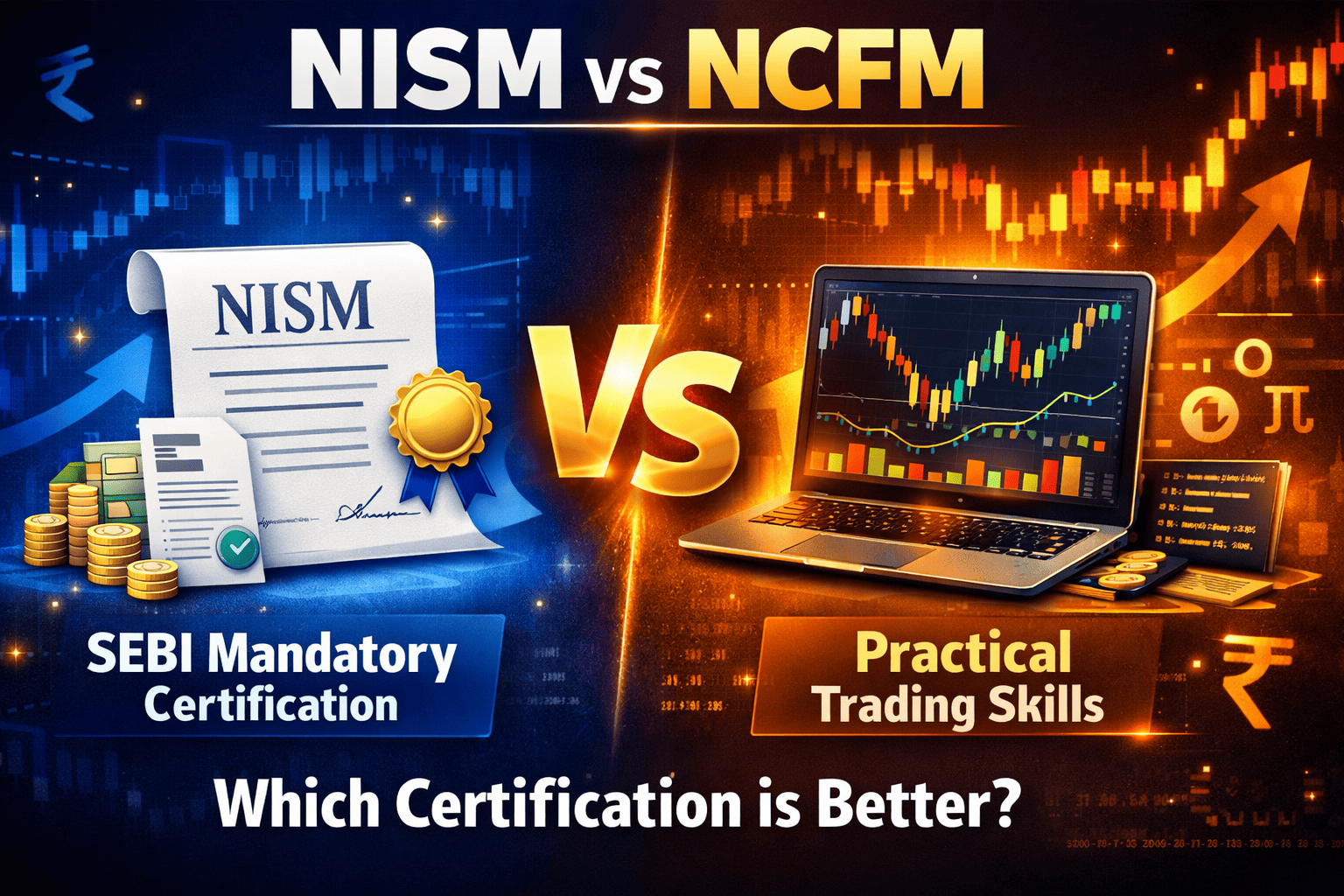
If you are planning to build a career in India's financial markets, chances are you have already heard of two popular certification programs — NISM and NCFM. Both are widely respected in the industry, but they serve very different purposes. Choosing the wrong one can waste your time, money, and effort. This guide breaks down everything you need to know — from what each certification covers, who it is meant for, how difficult the exams are, how long the certificates last, and most importantly, which one is right for your career goals in 2026.
💡 Quick Answer: NISM gives you the regulatory license. NCFM gives you the practical edge. For most beginners, NISM is the right place to start.
What is NISM?
NISM stands for National Institute of Securities Markets. It is an educational initiative established by the Securities and Exchange Board of India (SEBI) in 2006. Since SEBI is the regulator of all securities markets in India, NISM certifications carry strong regulatory weight. The primary goal of NISM is to ensure that professionals working in various segments of the capital markets — mutual funds, equity derivatives, research analysis, investment advisory, and more — have standardized, verified knowledge. SEBI has made several NISM certifications mandatory under its regulations, meaning you simply cannot work in certain roles without them.
Key NISM Exam Series:
- •NISM Series V-A: Mutual Fund Distributors — Mandatory to sell mutual funds in India
- •NISM Series VIII: Equity Derivatives — Required for equity derivatives dealers
- •NISM Series X-A & X-B: Investment Adviser — Mandatory to register as SEBI Investment Adviser
- •NISM Series XV: Research Analyst — Required to work as a SEBI-registered research analyst
- •NISM Series I: Currency Derivatives — For currency segment professionals
- •NISM Series XIII: Common Derivatives — For derivatives market participants
What is NCFM?
NCFM stands for NSE's Certification in Financial Markets. It was launched in 1998 by the National Stock Exchange of India (NSE), making it one of the oldest financial market certification programs in the country.
NCFM's primary objective is to develop practical, hands-on knowledge among market participants — traders, brokers, financial analysts, and investment professionals. Unlike NISM, NCFM certifications are generally not mandatory for regulatory compliance, but they are widely valued in the industry for demonstrating practical skills.
NCFM offers over 50 modules structured across three levels: Foundation, Intermediate, and Advanced.
Popular NCFM Modules:
- •Financial Markets: A Beginners Module (Foundation)
- •Capital Market (Dealers) Module (Intermediate)
- •Equity Derivatives: A Beginners Module (Intermediate)
- •Options Trading Strategies Module (Advanced)
- •Technical Analysis Module (Advanced)
- •Algorithmic Trading Module (Advanced)
Key Differences Explained:
1. Regulatory Authority:
NISM is backed by SEBI, the apex regulator of Indian securities markets. This gives NISM certifications strong legal standing. NCFM is backed by NSE, the country's largest stock exchange. Both are recognized in the industry, but NISM's regulatory mandate makes it non-negotiable for certain roles.
2. Mandatory vs Optional:
This is arguably the most important difference. NISM certifications are legally required by SEBI for professionals in specific roles — mutual fund distribution, investment advisory, research analysis, depository operations, and more. If you want to work in these roles, you must clear the relevant NISM exam. There is no alternative. NCFM certifications, on the other hand, are entirely optional. They are not required by any regulator or law. However, they are widely valued by employers, especially in trading and brokerage firms, as proof of practical market knowledge.
3. Number of Exams and Modules:
NCFM offers more than 50 modules ranging from beginner to advanced level. NISM currently conducts over 20 exam series. While NCFM offers more variety in terms of topics — including banking, insurance, and risk management — NISM modules go deeper into regulatory frameworks and compliance requirements.
4. Certificate Validity:
NISM certificates are valid for 3 years from the date of passing. You must renew by passing the exam again (or completing a Continuing Professional Education program) once they expire. This ensures professionals remain current with evolving SEBI regulations. Most NCFM certificates, in contrast, are valid for lifetime. Once you pass, you do not need to retake the exam unless the syllabus undergoes major changes. This is a significant practical advantage for those who do not want to worry about recurring renewals.
5. Difficulty Level:
NISM exams are generally considered more conceptually demanding. They test in-depth understanding of financial products and SEBI's regulatory framework, including specific rules, obligations, and compliance requirements. The passing percentage is typically 50% to 60% depending on the series. NCFM exams are considered easier, especially at the Foundation and Intermediate levels. They are more application-oriented, testing your ability to apply market concepts in practical scenarios. Advanced NCFM modules, however, can be quite challenging.
6. Study Material:
NISM provides free official workbooks (usually around 200 pages per series) in PDF format on their website. The material is regularly updated in line with regulatory changes. NCFM study material is available on the NSE Academy website, though it may not be updated as frequently as NISM content.
Which Career Paths Require NISM vs NCFM? Careers That Require NISM (Mandatory)
- Mutual Fund Distributor / ARN Holder — NISM Series V-A
- SEBI Registered Investment Adviser (RIA) — NISM Series X-A & X-B
- SEBI Registered Research Analyst — NISM Series XV
- Stock Broker / Sub-Broker / Equity Dealer — NISM Series VII or VIII
- Depository Participant Agent — NISM Series VI
- Compliance Officer at a Broking Firm — NISM Series III-A
- Careers Where NCFM Adds Strong Value
- Equity Trader / Proprietary Trader
- Options and Derivatives Specialist
- Technical Analyst or Chartist
- Financial Market Operations Executive
- Risk Management Professional
- Algorithmic Trading Developer
Who Should Choose NISM?
Choose NISM if you want to work in a regulated capacity — as a mutual fund distributor, investment adviser, research analyst, or any role mandated by SEBI. NISM is also the right choice for beginners who want a structured, authoritative introduction to India's securities markets.
NISM is particularly well-suited for:
- Fresh graduates looking to enter financial advisory or distribution
- Banking professionals who want to cross-sell investment products
- Compliance and operations staff at brokerage or AMC firms
- Anyone looking to register with SEBI as an advisor or analyst
Who Should Choose NCFM?
Choose NCFM if you are interested in developing practical, technical trading skills — especially in derivatives, options strategies, technical analysis, or algorithmic trading. NCFM is ideal for those already in the industry who want to deepen their expertise in specific market segments.
NCFM is particularly well-suited for:
- Traders and dealers at broking firms looking for skill upgrades
- Finance graduates who want to specialize in derivatives or technical analysis
- Professionals who want lifetime valid credentials without renewal pressure
- Individuals who already hold NISM certifications and want to enhance their practical knowledge
Can You Do Both NISM and NCFM?
Absolutely — and many finance professionals do exactly that. NISM and NCFM are not competing certifications. They complement each other very well.
A typical career path could look like this:
- Start with NISM Series V-A (Mutual Fund Distributors) to get your regulatory credential
- Then add NISM Series VIII (Equity Derivatives) if you plan to work in derivatives
- Later pursue NCFM's Options Trading Strategies or Technical Analysis modules to sharpen your practical skills
- Holding both types of certifications signals to employers that you are not just compliant, but also genuinely skilled — a powerful combination.
NISM Exam Registration:
- Register on the official NISM website: www.nism.ac.in
- Exam fee: Generally ranges from ₹1,500 to ₹2,000 per exam series
- Exams are conducted at NISM-authorized test centres across India
- Results are declared immediately after the exam
NCFM Exam Registration:
- Register on the NSE Academy website: www.nseacademy.com
- Exam fee: Generally ranges from ₹1,500 to ₹2,500 depending on the module
- Exams are conducted online at NSE-affiliated test centres
- Results are usually declared instantly after the exam
Final Verdict: NISM vs NCFM — Which is Better?
There is no universal winner in the NISM vs NCFM debate. The right choice depends entirely on your career goals, your current role, and what you want to achieve.
Bottom line: If you are starting out, begin with NISM — it opens regulatory doors that no other certification can. Once you have your NISM credential, layer on NCFM modules to build practical depth in your area of specialization.
Ready to Start Your NISM Preparation?
Practice with free NISM mock tests at PassNISM.in and boost your confidence before exam day.